• Home
  • LEGACY WORK
  • About
  • More
    • Home
    • LEGACY WORK
    • About

  • Home
  • LEGACY WORK
  • About

verizon international travel widget

Overview

Project Context

Project Context

  • Project: International Travel Widget
  • My Role: Senior UX Designer
  • Team: Product, Engineering, CMI, International, Content
  • Viewport: Desktop/Mobile
  • Goal: Help customers quickly identify personalized international travel support without contacting customer service.

Project Context

Project Context

Project Context

  • Fast-paced production initiative 
  • 2–3 week design timeline 
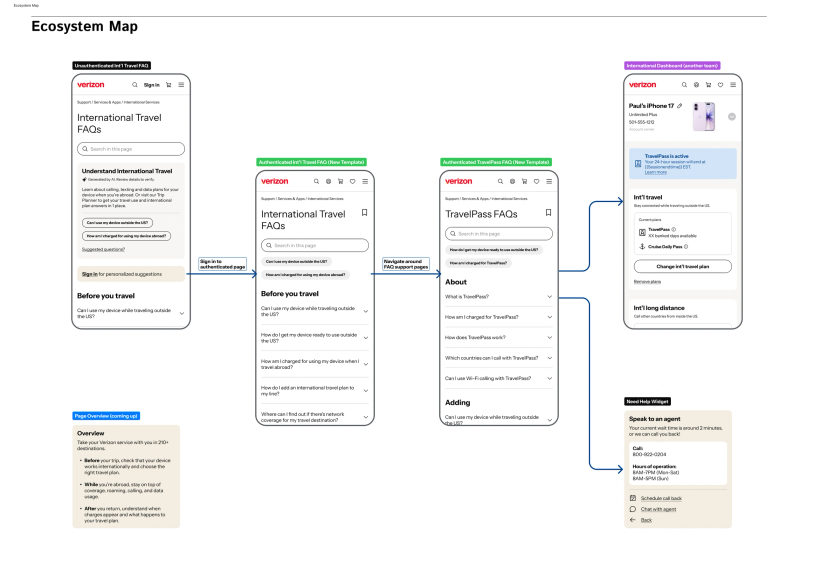
  • Part of a broader self-service ecosystem 
  • Cross-functional collaboration across Product, Engineering, CMI, and International teams 
  • Designed for phased iteration and future AI-driven extensibility

The problem

Business Challenge

Customers planning international travel often struggled to quickly understand the complex types of int’l services, billing and eligibility, and therefore had higher support dependency.

Design Challenges

  • Simplify the offerings to clear, intuitive bullet points in limited space.
  • Make sure the widget sits well with the existing templates and components in work.
  • Launch by deadline.

Product Gap

The initial request was ambiguous and open-ended, with 4 broad user types, 5 product categories, and high-level goals, without a clear interaction model. 

Discovery & Research

Cross-functional Alignment

Cross-functional Alignment

Cross-functional Alignment

I facilitated discussions across:

  • Product
  • International Business
  • Engineering
  • CMI / Customer Insights
  • Content

to align user behavior, plan details, business priorities and technical feasibility

Research Inputs

Cross-functional Alignment

Cross-functional Alignment

I reviewed:

  • Customer research
  • Behavioral insights
  • Support pain points
  • Existing service pathways
  • Product constraints
  • Technical limitations

Findings

Cross-functional Alignment

Findings

  1. Users wanted quick confidence

Travelers wanted immediate reassurance: “Am I covered?”

2.    Too many paths increased hesitation

Too many categories and complex FAQ articles made decision-making harder.

3.      Support-first behavior

When uncertain, users defaulted to contacting support.

Category breakdowns

User Types

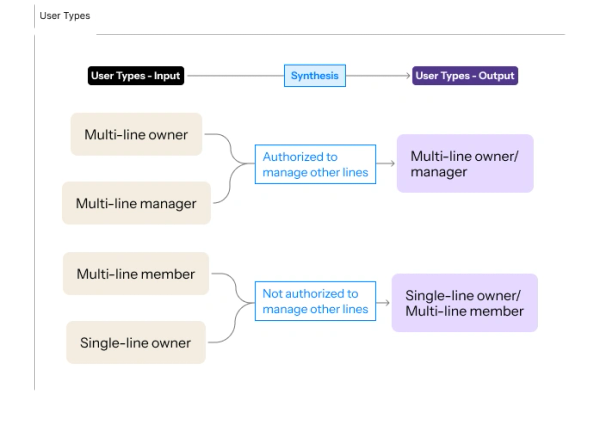
I restructured the original four broad user segments into two functional user types based on core travel-related use case scenarios, helping simplify decision-making and reduce unnecessary branching.
Plan Categories

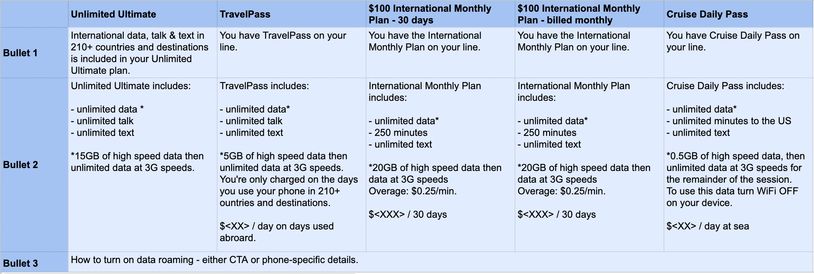
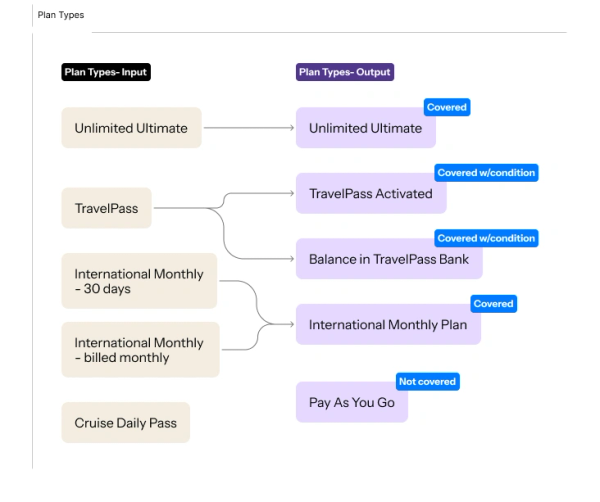
I also redefined the original five requested plan categories into five optimized plan types, informed by user research, behavioral insights, and service content, to better align with how customers actually evaluate international travel needs.

User Flow

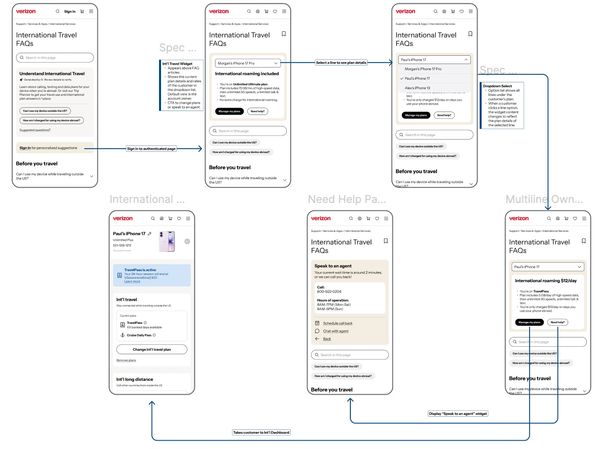
Single-line Owner / Member
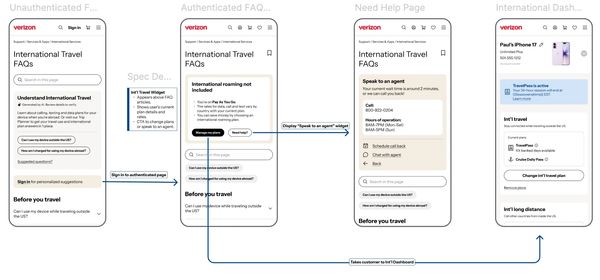
Multi-line Owner / AcManager

Prototype

    Retrospective

    Trade-off

    The biggest tradeoff was between designing for long-term system consistency versus meeting a hard launch deadline. I wanted to further refine the experience so it aligned with other AI components and a new page template that were already in development, which would have created a more cohesive ecosystem. But delaying launch would have impacted business timelines and user needs. I worked with the team to prioritize the most critical experience improvements for Phase I and launched a streamlined version first, while documenting additional refinements for Phase II. That approach balanced speed with usability while still creating a foundation for future scalability.

    Outcome

    Results directionally showed improved discoverability and strong engagement with personalized travel widget for authenticated users, and a noticeable lowered call volume on international travel support. 

    Reflection

    By shipping a focused Phase I solution, I was able to improve usability quickly while preserving a roadmap for longer-term consistency and scalability.

    Copyright © 2026 Juliet Sun - All Rights Reserved.


    Powered by

    This website uses cookies.

    We use cookies to analyze website traffic and optimize your website experience. By accepting our use of cookies, your data will be aggregated with all other user data.

    Accept